
Blackford County Superior Court Overview
The Blackford County Superior Court is one of Blackford County's two county trial courts. The Indiana court directory lists Hon. John N. Barry as the Superior Court judge. The official county page lists the Superior Court at 110 W. Washington Street, Hartford City, IN 47348, with phone 765-348-1840 and fax 765-348-5317. The court shares the courthouse address with the Circuit Court and the Blackford County Clerk.
Indiana's trial-court structure can be confusing because circuit and superior courts often perform similar trial-court work. The Indiana Judicial Branch explains that both labels exist because of state law and local history. In Blackford County, the important practical point is not the title alone. A person searching for a record should identify the exact court shown in MyCase, on a notice, on a citation, or on a filed document, then contact that court or the Clerk using the correct case information.
The Superior Court is part of the state trial-court system, not a federal court and not a separate online database. Public records are searched through Indiana MyCase when available. Official copies, certified copies, older files, and case documents not linked online are handled through the Blackford County Clerk, the recordkeeper for both Circuit and Superior Court files.
Blackford County Court Contact Table
The Superior Court sits inside a small courthouse-centered justice system. The Clerk, Circuit Court, Superior Court, and Probation office all publish the courthouse address, while Community Corrections and the Prosecutor are nearby in Hartford City. Use the court name shown on the case record before calling because the Circuit and Superior Court phone and fax numbers are different.
| Court / Office | Judge / Official | Address | Phone | Fax |
|---|---|---|---|---|
| Superior Court | Hon. John N. Barry | 110 W. Washington, Hartford City, IN 47348 | 765-348-1840 | 765-348-5317 |
| Circuit Court | Hon. Brian Bade | 110 W. Washington, Hartford City, IN 47348 | 765-348-2901 | 765-348-7213 |
| Clerk's Office | Kimberly Pitts, Clerk | 110 W. Washington, Hartford City, IN 47348 | 765-348-1130 | 765-348-7234 |
| Probation | Department office | 110 W. Washington, 3rd Floor, Hartford City, IN 47348 | 765-348-7210 | 765-348-7205 |
| Community Corrections | Department office | 117 N High Street, Hartford City, IN 47348 | 765-348-7214 | Not located |
The official county Superior Court page is the manifest source for the image below. It is one of the clearest local references for the Superior Court address, phone, and fax information used when distinguishing Superior Court records from Circuit Court records.
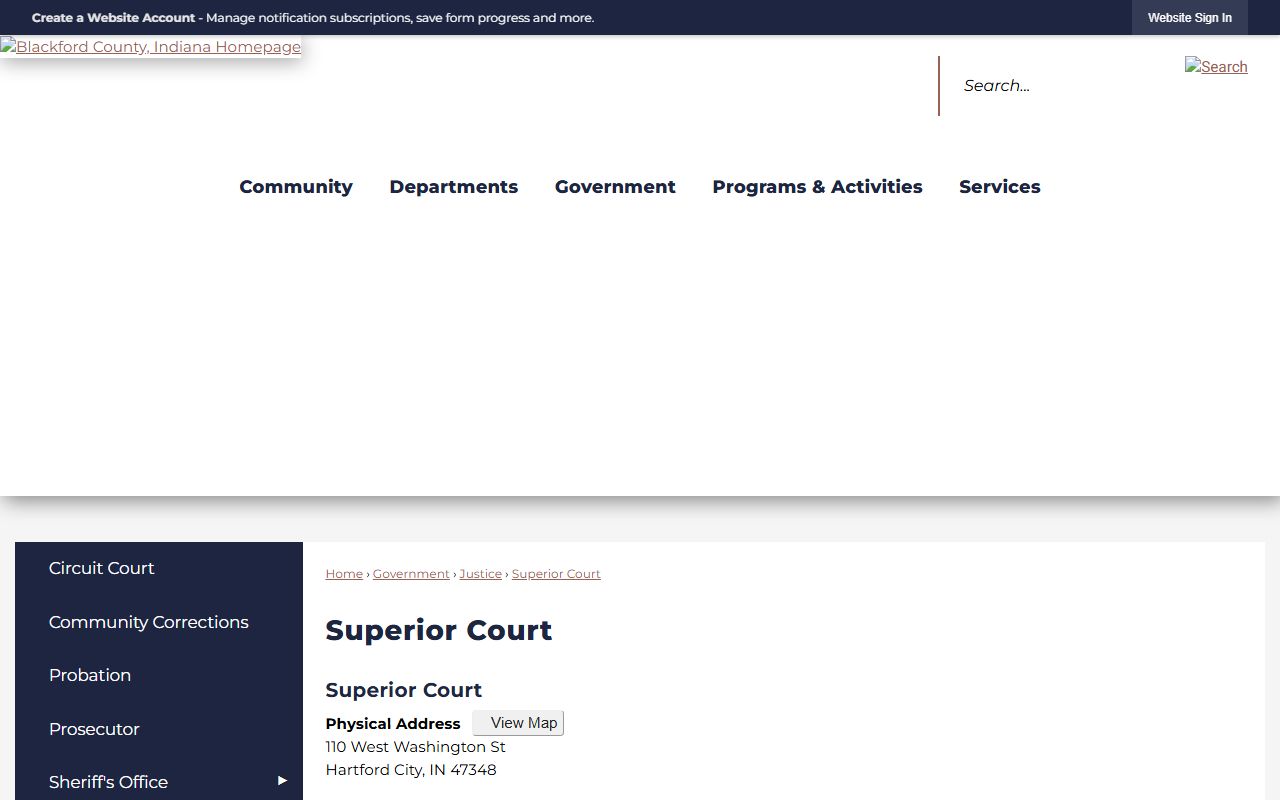
Because both county trial courts are in the same courthouse, a person should not rely on the building address alone. The court name, case number, judge, and MyCase entry identify the correct docket.
Superior Court vs. Circuit Court vs. City or Town Court
Blackford County has both a Superior Court and a Circuit Court. The research did not identify a separate county court, justice court, or Blackford city or town court page in the county justice menu. Indiana's lower-court category includes city and town courts, so citation and ordinance cases should be checked by the issuing location and the court printed on the citation.
| Superior Court | Circuit Court | City / Town Court | |
|---|---|---|---|
| Local role | Companion Blackford County trial court. | County trial court with local-rule probate and mental-health filing allocation. | Lower local court category in Indiana, if established for the municipality. |
| Judge | Hon. John N. Barry. | Hon. Brian Bade. | Not located in Blackford County justice menu research. |
| Recordkeeper | Blackford County Clerk. | Blackford County Clerk. | Confirm with the court named on the citation or local notice. |
| Search path | MyCase first, Clerk for official copies. | MyCase first, Clerk for official copies. | Use the issuing court information and statewide search where available. |
How a Case Moves Through Superior Court
A Superior Court case usually begins with a filing, charge, citation, or other initiating document submitted to the court system. The Clerk opens and maintains the file, and the case then develops through notices, appearances, hearings, orders, and final disposition. MyCase may show the case status, party names, event history, public documents, financial information, and a payment button when available. It may not show every document, and it is not the official record.
Criminal flow: arrest or prosecutor review › charge filed › initial hearing › bond and pretrial settings › motions or plea negotiations › trial or plea › sentencing › probation or appeal.
Civil flow: complaint or petition › summons and service › answer or default deadline › motions and discovery › hearing or trial › judgment › collection, compliance, or appeal.
Traffic and ordinance flow: citation issued › case or citation lookup › payment, deferral, contest, or hearing › disposition › possible BMV driver-record consequences. The Clerk page says traffic violations are paid by cash or money order.
Civil, Family, Criminal, and Traffic Records
Superior Court records can touch many practical record needs: criminal cases, civil matters, family-law records, small claims, evictions, infractions, ordinance cases, court costs, and post-judgment activity. The exact case type should be confirmed from MyCase or the court notice. Family and dissolution records may include petitions, financial declarations, custody orders, child-support orders, and final decrees. Criminal records may include charges, bond entries, hearings, plea agreements, sentencing orders, and probation conditions.
Some material is restricted even when a case exists. Indiana Rules on Access to Court Records, Rule 5, excludes or redacts sealed records, confidential filings, personal identifiers, victim and witness contact information in certain cases, many juvenile records, adoption material, medical or treatment records, and entire mental-health cases filed under Indiana Code 12-26. A missing MyCase document is not proof that no record exists. It may be unavailable online, confidential, sealed, or held only in the local court file.
Judicial District 15 and E-Filing
Blackford County is part of Indiana Judicial District 15, together with Delaware, Henry, Jay, and Randolph counties. The state court gateway for Blackford County links users to case search, e-filing, statistics, and local rules. Local rules matter because they can allocate case categories between Blackford County courts. For example, the research identifies probate and mental-health filing allocation to Circuit Court, which means a person looking for those categories should not assume they are Superior Court matters.
Indiana statewide e-filing is the filing channel for many court papers by parties and attorneys. It is separate from public case lookup and separate from certified-copy requests. The e-filing page in the manifest is included because it is an official state resource used by Blackford County court users who need to submit filings rather than simply view a public record.
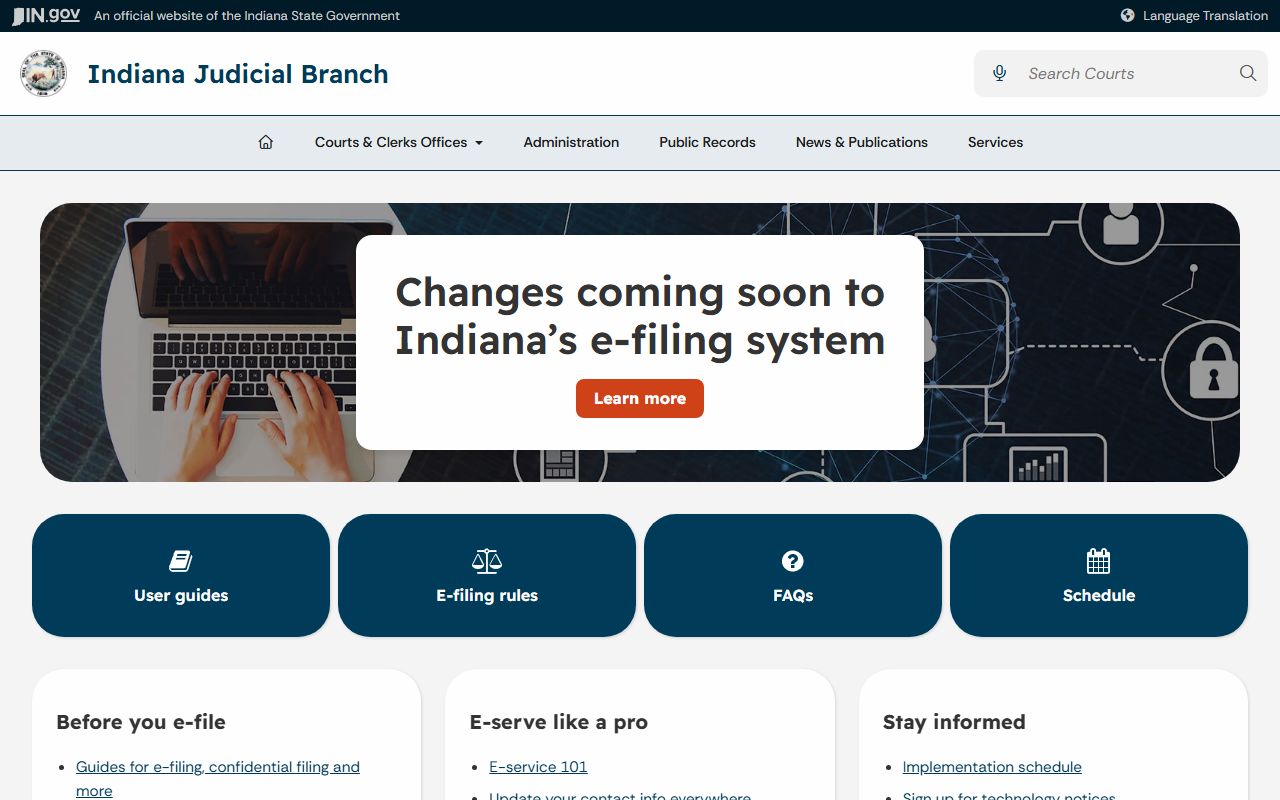
After a filing is accepted, the public availability of any resulting case entry or document depends on MyCase coverage, the case type, the court record, and Indiana access rules.
Lower Courts and Courthouse Context
The research map lists city and town courts as lower-court categories in Indiana, but no Blackford city or town court page was located in the official county justice menu. For a citation, ordinance, or municipal issue, the best source is the exact court name printed on the citation or shown in MyCase. If the case is in Superior Court, call 765-348-1840 for court-office questions and the Clerk at 765-348-1130 for official record copies.
The Superior Court operates in the historic Blackford County Courthouse, a downtown Hartford City landmark. Official history material identifies the courthouse as the county's second courthouse, built from 1893 to 1895, with Richardsonian Romanesque design, Montpelier quarry foundation stones, a 165-foot clock tower, and National Register listing in 1980. The same building is a working public-records location, so visitors should confirm hearings, copy procedures, payment methods, and security restrictions before traveling.